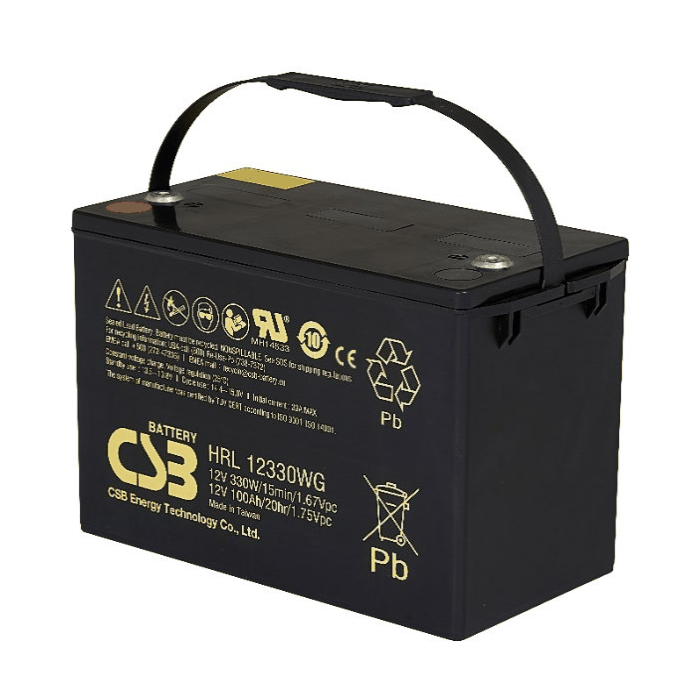
12V 100Ah VRLA Battery | CSB HRL12330WG
HRL12330WG is a 12V VRLA battery in CSB's HRL series, with a nominal capacity of 100Ah at the 20-hour rate and a 15-minute rate power of 330W; it uses pure lead and AGM technology, has a design life of up to 10 years, and is mainly intended for data center UPS and other applications requiring high-power float standby.
Taobao store
WeChat procurement
Product Features
- The battery's technical type is valve-regulated lead-acid (VRLA)
- With AGM (Absorbent Glass Mat) technology, it is maintenance-free, and gas recombination efficiency can reach up to 99%
- In addition to a pure lead structure, proprietary elements are added
- Designed specifically for high-rate UPS and float-charge standby power applications
- Production follows IEC 60896-21/22:2004 standards and has obtained UL1989 recognition (MH14533)
Application Scenarios
- UPS backup for large data centers
- High-voltage DC backup for cloud computing centers
- Uninterruptible power supply for financial trading systems
- UPS emergency backup for communications hubs
- High-power UPS backup for industrial automation
- UPS backup for rail transit signaling
Product parameters
- Model:HRL12330WG
- Voltage:12 Vdc
- Nominal Capacity:330W @ 15min-rate (1.67C) 100AH@ 20hour-rate (1.75V)
- Watts per Cell:627 (5-Min 1.67 VPC @ 25°)
- Watts per Cell:356 (15-Min 1.67 VPC @ 25°)
- Max. Charge Current:33.0A
- Max. Discharge Current:800 A
- Short Circuit Current:2386 A
- Internal Resistance:3.50 mΩ
- Terminal Type:I2 thread lead alloy terminal to accept M6 bolt
- Terminal Torque:51.7±10.3 Kgf·cm / 44.9±9.0 Lbf·in / 5.10±1.0 N·m
- Container Material:PP (UL 94-HB) standard, flame-retardant (94-V0) available upon request
- Weight:29.60 / 65.24 kg / lb.
- Length (L):324.7±2.5 / 12.78±0.10 mm / in
- Width (W):169.0±2.0 / 6.65±0.08 mm / in
- Height (H):213.6±2.5 / 8.41±0.10 mm / in
- Design Life:Up to 10 years in standby service at 25°C; Eurobat (20°C): >12 years, Very Long Life
- Float Charging Voltage:13.5 - 13.8 Vdc/battery
- Equalizing Charging Voltage:14.4 - 15.0 Vdc/battery
- Operating Temperature:discharge -15°C to 50°C; charge/storage -15°C to 40°C
Product details
HRL12330WG is mainly used for high-rate UPS and float standby power. As a member of the CSB HRL series, this series covers 6V and 12V top-terminal valve regulated sealed lead acid batteries and uses AGM (Absorbent Glass Mat) technology, with gas recombination efficiency of up to 99%, enabling maintenance-free operation. This model has a nominal voltage of 12 Vdc, a nominal capacity of 100Ah at the 20-hour rate (1.75V); a 15-minute rate power of 330W (1.67C), a 5-minute rate power of 627 W/cell, and a 15-minute rate power of 356 W/cell. The pure lead construction and proprietary formula together support the above high-rate and float standby applications.
Terminals: HRL12330WG uses I2 threaded lead alloy terminals, can be fitted with M6 bolts, and has a recommended torque of 51.7±10.3 Kgf·cm, 44.9±9.0 Lbf·in, or 5.10±1.0 N·m. At 25°C, the float voltage range is 13.5 to 13.8 Vdc/battery, and the equalizing charge voltage range is 14.4 to 15.0 Vdc/battery. The battery has a maximum charge current of 33.0A, a maximum discharge current of 800 A, a short-circuit current of 2386 A, and an internal resistance of 3.50 mΩ.
Temperature specifications are as follows: nominal temperature 25°C; discharge is allowed from -15°C to 50°C; charging and storage are from -15°C to 40°C. After standing for 90 days in a 25°C environment, self-discharge is less than 10%, and it can be stored for up to 6 months; it must be fully charged before use, and if the storage temperature is above 25°C, charge it earlier. In terms of construction, the case is PP (UL 94-HB), and flame-retardant (94-V0) versions can be supplied on request. The battery is 324.7±2.5 mm long, 169.0±2.0 mm wide, 213.6±2.5 mm high, and weighs approximately 29.60 kg.
This model is manufactured in accordance with IEC 60896-21/22:2004 and is recognized under UL1989 (MH14533). Under 25°C float service, the design life can reach 10 years, meeting the Eurobat long life standard (greater than 12 years at 20°C, Very Long Life). Its official application area is data center uninterruptible power supply (Datacenter UPS), suitable for float standby scenarios requiring high power output.