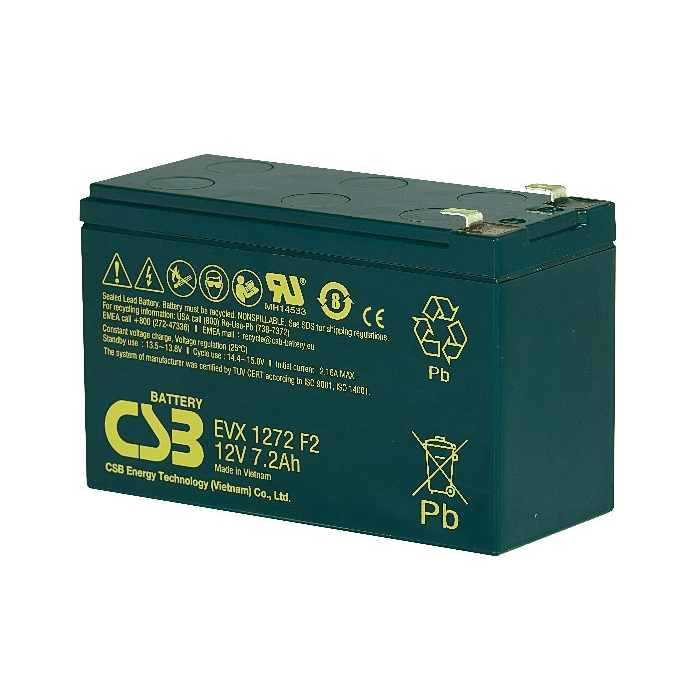
CSB EVX1272 Battery (12V 7.2Ah, Valve-Regulated Sealed Lead-Acid)
The EVX1272, intended for electric mobility and deep cycle applications, is from the CSB EVX series. It is a 12V 7.2Ah valve-regulated sealed lead-acid (VRLA) battery with AGM and pure lead construction; its nominal capacity at the 20-hour rate is 7.2Ah, and its design life under 25°C and 100% DOD can reach 400 cycles.
Taobao store
WeChat procurement
Product Features
- Valve-regulated lead-acid (VRLA) construction
- Maintenance-free; with absorbent glass mat (AGM) technology, gas recombination efficiency can reach 99%
- Internal pure lead construction with proprietary elements
- Designed for electric mobility and deep-cycle applications
- Manufactured to IEC 60254-1:2005 / IEC60254-2:2008 standards, and UL1989 recognized (MH14533)
Application Scenarios
- Traction batteries can be used in electric wheelchairs and mobility scooters
- Traction power supplies can be used in electric scooters
- Traction batteries can be used in electric power-assisted bicycles
- Auxiliary power supplies can be used in motorhomes and recreational vehicles
- Batteries can be used in golf carts and park sightseeing vehicles
- Power supplies can be used in short-distance, low-speed electric mobility vehicles
Product parameters
- Model:EVX1272
- Voltage:12 Vdc
- Nominal Capacity:7.2 Ah @20hr-rate
- Ah Capacity:6.00 (8-Hr 1.75 VPC @ 25°C)
- Ah Capacity:7.20 (20-Hr 1.75 VPC @ 25°C)
- Ah Capacity:5.76 (8-Hr 1.80 VPC @ 25°C)
- Max. Charge Current:2.16 A
- Max. Discharge Current:130 A
- Short Circuit Current:292 A
- Internal Resistance:23.9 mΩ
- Terminal Type:F2 terminal (Faston Tab 250)
- Container Material:ABS (UL 94-HB)
- Weight:2.55 / 5.62 kg / lb.
- Length (L):150.9±2.0 / 5.94±0.08 mm / in
- Width (W):64.8±1.0 / 2.55±0.04 mm / in
- Height (H):98.6±1.0 / 3.88±0.04 mm / in
- Design Life:400 cycles at 100% DOD (25°C); 1800 cycles at 30% DOD (25°C)
- Equalizing Charging Voltage:14.4 - 15.0 Vdc/battery
- Operating Temperature:discharge -15°C to 50°C; charge/storage -15°C to 40°C
- Note:F1 terminal is available; Max Discharge Current = 100 A (5 sec.)
Product details
The EVX1272 is a 12V valve-regulated sealed lead-acid battery in the CSB EVX product line, with terminals located on top. Its separator uses AGM absorbent glass mat technology, and gas recombination efficiency can reach up to 99%; it also uses pure lead construction and a proprietary formulation. This series is aimed at electric mobility and cyclic energy storage, pursuing durable deep-cycle pure lead performance; for the EVX1272, the official application direction is electric mobility.
For capacity data, at 25°C, 1.75VPC, and 20-hour rate, the nominal capacity is 7.2Ah. The data also lists: 6.00Ah at 25°C, 1.75VPC, 8-hour rate; 7.20Ah at 25°C, 1.75VPC, 20-hour rate; 5.76Ah at 25°C, 1.80VPC, 8-hour rate. Maximum charge current is 2.16A; maximum discharge current is 130; short-circuit current is 292A; internal resistance is 23.9mΩ.
Dimensions and construction: length 150.9±2.0mm, width 64.8±1.0mm, height 98.6±1.0mm, weight 2.55kg, terminal is F2 Faston Tab 250. Case material is ABS, flame retardant rating UL 94-HB. Equalization charge voltage at 25°C is 14.4 to 15.0Vdc; float charge voltage data is not provided. Temperature conditions: nominal 25°C; discharge can be at -15°C to 50°C; charging and storage can be at -15°C to 40°C.
Cycle life and self-discharge: at 25°C and 100% depth of discharge, cycle count can reach 400; at 30% depth of discharge, cycle count can reach 1800. Stored at 25°C for 90 days, capacity loss is less than 10%, and the storage limit is 6 months; fully charge before reuse, and if the storage temperature exceeds 25°C, supplementary charging should be earlier. Manufacturing standards include IEC 60254-1:2005 and IEC 60254-2:2008, and it has obtained UL1989 recognition (MH14533).
Therefore, the EVX1272 is suitable for electric mobility and deep cycle applications. The maintenance-free design and AGM gas recombination technology can reduce routine maintenance frequency. When selecting a model, actual discharge rate, ambient temperature, and cycle depth should be taken into consideration, and capacity and life data in the documentation should be referenced for judgment.